Earn Funding Fees Without Predicting the Market
In traditional markets there are derivatives called futures.
They allow traders to speculate on an asset, use leverage, and go short without owning the underlying financial instrument.
These markets have an expiration date and were originally created for commodity trading.
Cryptocurrencies also have futures markets. There are also perpetual futures (the ones we are interested in here).
They have all the main features of regular futures, such as leverage and the ability to go short, but they never expire.
Going short means making a profit if the market goes down and losing money if the market goes up.
On the other hand, buying or going long means making a profit when the market goes up and losing money when the market goes down.
Leverage allows traders to operate with more money than they actually own.
The broker or exchange provides the additional capital. If our losses get too close to the amount advanced by the broker, the position will be liquidated, meaning it will be closed automatically by force.
As mentioned before, futures are derivatives and do not involve ownership of the underlying asset.
If perpetual futures never expire and there is no “physical” underlying asset, how can their price stay aligned with the spot market price?
To solve this problem, funding rates were introduced.
If an exchange believes it is necessary to attract more sellers (short sellers) to a specific futures market, these traders are incentivized by receiving a fee (usually every 4 or 8 hours, 24/7). At the same time, buyers are encouraged to close their positions by paying this fee to the sellers.
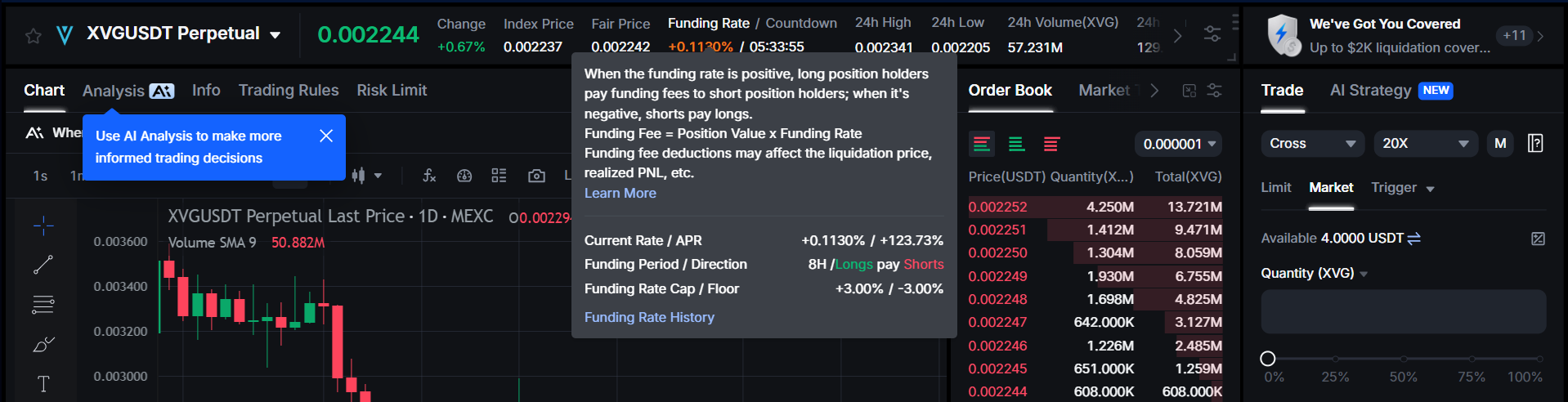
The opposite happens when the market needs more buyers and fewer sellers.
Funding rates are not random. They are calculated mathematically, historical data is available, and traders can know in advance the percentage that will be paid or received in the next funding round.
Looking at historical data, we can say that short sellers have generally benefited from this dynamic.
In general,
- During a bull market, funding rates tend to pay very high fees to short sellers.
- During sideways markets, the fees usually decrease but still tend to favor short sellers.
- During bearish markets, it becomes harder to profit from these dynamics compared to a strong bull market, but interesting and profitable opportunities for short sellers still exist.
Another advantage of being short is the ability to hedge the position by buying the same coin on the spot market.
For example, if I have a position of -1 BTC (meaning I am short 1 BTC on the perpetual futures market) and I buy 1 BTC on the spot market at the same price where I sold it, any price movement will have little to no impact on the overall balance of my portfolio.
If the price goes up, the losses from the short position are offset by the profits on the spot position, and vice versa.
This condition is called market neutrality or delta neutrality, and it allows us to collect funding fees without worrying about the direction of the market price.
Funding Rate Arbitrage vs Directional Trading
Compared to directional trading, this strategy focuses on passive profits that accumulate over time, without requiring intervention once the position has been opened.
There is no need to bet on the future direction of the market.
The goal is to identify the best opportunities and let capital work together with time.
Unlike discretionary trading, this is not about luck. It is about logic.
A funding rate trader thinks more like a business manager: the cost of a trade is evaluated, the time needed to recover that cost is calculated, and during the lifetime of the position the trader continuously evaluates whether more profitable opportunities have appeared.
Emotions are removed from the process, and if the risk is managed by software such as DegenWings, there are no unexpected events capable of destroying months or years of work, as can happen with discretionary trading.
DegenWings provides a calculator designed to evaluate these trades, a market screener updated multiple times throughout the day to help identify the best opportunities, and a list of risky markets to avoid.
There are no free lunches on Wall Street
…and there are none in crypto either.
Thinking that a simple strategy, requiring little time and offering high returns, carries no risk just because it is market neutral would be foolish.
There are several risks involved, and DegenWings is designed to manage all of them, completely changing the strategy’s risk-reward profile.
Let’s look at them in the following article.
Risks of Funding Rate Arbitrage: Everything That Can Go Wrong